Touchprints
Handprint or Footprint for a Newborn: Which Is Actually Easier?
It's 6:40 on a Tuesday morning, my daughter is nine days old, and I have her entire fist in my hand. The fist is winning.
I have done the reading. I have the child-safe ink pad, the prep wipe, the little practice sheet I told myself I'd only need once. I peel one finger back and the other four tighten. I get that one and the first one curls again. It's like squeezing a very small, very determined water balloon. Every parent who has tried this at two weeks knows the exact feeling I'm describing, and every one of them made the same face I was making.
Uh-oh.
So I did what the internet told me not to do, which is give up on the hand and look at the foot instead. The foot just sat there. Flat, open, uninterested in my whole project. And that's when I understood something nobody had said plainly: for a brand-new baby, these two keepsakes are not the same difficulty at all.
Is a handprint or footprint easier for a newborn?
A footprint is easier for a newborn, almost every time. Newborns are born with a palmar grasp reflex, which means the second you touch their palm, the fingers curl shut. Feet don't do that. A baby's foot stays relaxed and open when they're calm or asleep, and babies are already used to having their feet handled during diaper changes and dressing, so there's no startle to fight. Less surprise, less fuss, cleaner print.
The hand fights back for a real, boring, biological reason, and it helps to know it isn't you.
Why won't a newborn open their hand?
The palmar grasp reflex is why, and it's completely normal. It shows up around eleven weeks before a baby is even born and usually sticks around until somewhere between three and six months, when the brain's higher motor centers mature and the reflex fades into voluntary movement. Until then, a light touch to the palm triggers the grab. It's the same reflex that lets a newborn clamp onto your finger hard enough that you start to wonder about their future grip strength.
Which is a long way of saying: the closed fist at two weeks is not a you problem. It's a scheduling problem.

So should you just take the footprint?
Take the footprint now, and take the handprint a little later. That's the honest answer, and it's the one most keepsake blogs skip because it doesn't sell you on doing everything in week one. If you want a print in those first newborn days, the foot is the safe bet. If you're set on a hand, wait until the grasp reflex loosens, roughly three to six months, or catch a newborn hand in the small window when they're deeply, floppily asleep and the fingers fall open on their own.
There's no wrong pick here. But there is a question underneath the question, and it's the one that actually decides this for most families.
Which one do you want to look at for the next twenty years?
Picture the finished keepsake on a shelf, and picture whose print it is. A footprint says "you were here, and you were tiny." A handprint says something a little different, because the hand is the part of us that does everything after: it waves, it holds a spoon, it grips a rail, it eventually palms a basketball. For a lot of parents, the hand is the one they want to freeze. That's allowed to change the timeline. Preserve the moment you actually want on the wall, not just the one that's easiest to grab at nine days old.
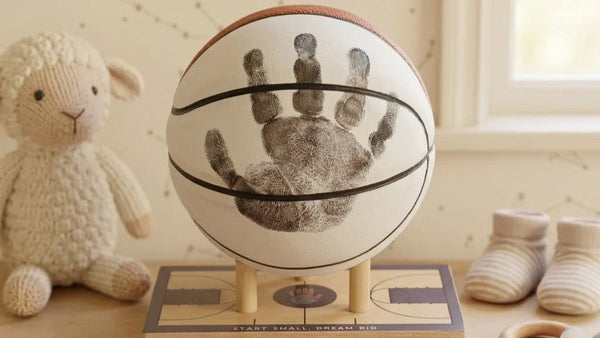
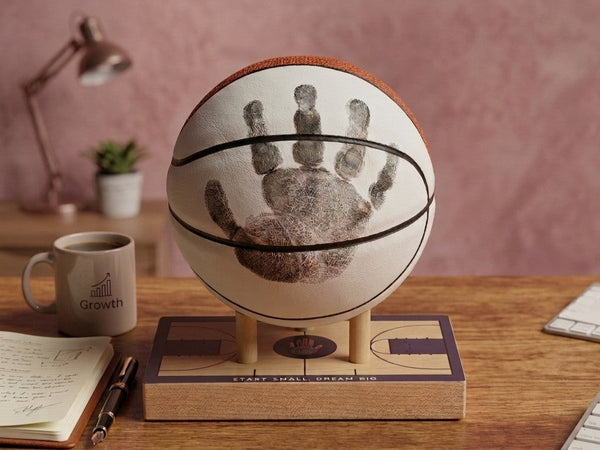
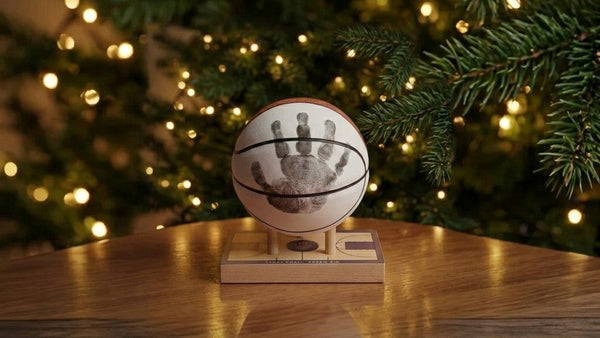
This is exactly where we landed on the sports-ball version of all this. A handprint pressed onto a display-quality five-inch basketball, sealed and mounted on a walnut or maple base, is built to be the print you keep out and see every day, not the one that fades in a drawer. And a hand is what fits the story: the small palm now, the ball it grows into later. So on our kits we plan around the hand, which usually means we're telling people the same thing this whole post is telling you. Get the foot early if you want something now. Save the ball for the hand.

Football Handprint Kit Maple
Before they’re big enough to throw a spiral, there’s this. The Little Touchprints Football Kit captures your baby’s...
See the kitIf you want the technique for when you do go for the hand, we wrote the full how to take a newborn handprint walkthrough, including the sleeping-baby trick and how to actually get the fingers to cooperate. And if you're weighing the timing, our guide on preserving a handprint on a basketball covers the ball part start to finish. You can browse the full basketball keepsake collection whenever you're ready.

Quick answers
Is a handprint or footprint easier for a newborn?
A footprint. Newborn feet stay relaxed and open, while the palmar grasp reflex keeps a newborn's hand curled shut when you touch the palm.
When does a baby's hand open enough for a clean handprint?
Usually between three and six months, once the grasp reflex fades. Before that, your best shot is a newborn who is deeply asleep, when the fingers relax on their own.
Can I still take a newborn handprint if I really want one?
Yes. Wait for deep sleep, keep the ink pad and prep wipe ready, and work one hand at a time. It's harder, not impossible, and a calm sleeping baby makes all the difference.
Which lasts longer, ink or the print itself?
The print lasts as long as it's protected. A brush-on, water-based sealant applied like nail polish locks the ink in so it won't smudge or fade, which is what turns a one-time print into something you display for years.
Do I have to choose just one?
No. Plenty of families take a footprint in the newborn weeks and a handprint a few months later. They're different keepsakes from different chapters, and there's room on the shelf for both.
By the time my daughter was four months old, that same fist opened up on its own, flat and easy, right in the middle of a nap. I got the handprint on the second try. The fist didn't win after all. It was just running on a different clock than I was.
Little Touchprints makes handprint keepsake kits for sports balls, basketballs and footballs, with everything included: child-safe ink pad, prep wipe, brush-on sealant, and a walnut or maple display base. Built to be displayed, not stored. Questions about the process? Our FAQ has you covered.

Preserve this season before the next one starts.
Shop the kits