Every parent who's tried this knows the moment. The ink pad is ready. The paper is ready. You've got maybe a four-minute window before somebody needs a bottle. And your baby's hand is clenched shut like a vault.
You try to open it. It closes tighter. You try again. Now they're grabbing your finger with a grip strength that seems frankly unreasonable for someone who weighs eight pounds.
There's a reason this happens, and there's a way around it. Some of the advice out there will tell you newborn handprints basically can't be done, that you should wait five or six months and try again. We disagree. It's harder than a footprint, sure. But thousands of parents get clean newborn handprints, and the difference between the ones who do and the ones who end up with a smudge is technique, not luck.
Here's the technique.
Why won't my newborn open their hand?
It's called the palmar grasp reflex, and every baby is born with it. Touch a newborn's palm and their fingers close around whatever touched it, automatically, involuntarily, every time. It's the same reflex that lets them grip your finger on day one, which is one of the all-time great feelings, and also the exact thing working against you when you want that hand flat on a surface.
The reflex fades on its own somewhere around four to six months. So yes, waiting is an option. But the newborn window is when the hand is at its absolute smallest, and if that's the version you want to keep, waiting means losing it. That's the trade.
The good news: the reflex has an off switch. Two of them, actually.
The technique that actually works
Wait for deep sleep. This is the single biggest factor. A newborn in deep sleep goes fully slack — arms heavy, fingers loose, the works. Feed them, wait for the milk-drunk knockout, give it ten more minutes, and you'll find a hand that opens with almost no resistance. Trying this on an awake newborn is playing the game on hard mode for no reason.
Stroke the back of the hand, not the palm. Touching the palm fires the grasp reflex. Stroking the back of the hand does the opposite, the fingers relax and start to uncurl. Gentle strokes from the wrist toward the knuckles. Give it a few seconds. This feels like a magic trick the first time it works.
Uncurl from the pinky, one finger at a time. If the hand needs help the rest of the way, don't pry from the middle. Start at the pinky and ease each finger open in turn, supporting the wrist with your other hand. Slow beats strong here, every time.
Press from the heel of the hand toward the fingertips. When you make the print, roll the pressure from the base of the palm out through each finger, then lift straight up. No dragging, no sliding. Dragging is how a handprint becomes an abstract painting.
Get a second adult. One person manages the baby and the hand. The other manages the surface and the angle. Solo is possible. Two is civilized.
That's the whole system: asleep, back of the hand, pinky first, heel to fingertips, straight up. Fifteen minutes including setup, most of which is waiting for the deep-sleep window.
Start with the feet
Here's a trick worth stealing: do a footprint first.
Feet don't have a grasp reflex. That's why hospitals take footprints at birth without breaking a sweat, you hold the ankle, roll the foot heel to toe, done. Doing a footprint first is a no-stakes warm-up: you learn how the ink behaves, how much pressure you need, and how your baby reacts, all before attempting the harder print. And you end up with a footprint keepsake as a bonus, which nobody has ever regretted.
What if the print isn't perfect?
Then you're in good company. First attempts on a newborn often come out with a slightly curled pinky or a soft edge where a finger didn't fully commit. Two things about that.
First, you almost always get another attempt. A child-safe ink pad wipes off skin with a regular baby wipe, and there's no rule that says take one is the keeper.
Second, and we mean this, a slightly curled newborn handprint isn't a failure. It's an honest record of a hand that was three weeks old and had opinions. Some of the prints parents love most are the imperfect ones, because they look exactly like what they were. If you're interested in finding out the best way to do this mess free you can read out blog on it here.
When does it get easier?
Around four to six months, when the grasp reflex fades and the hand opens on its own. If you're reading this with a two-week-old and the whole thing feels like too much right now, that's a completely legitimate call, the window doesn't slam shut, it just changes what the print looks like. We wrote a full breakdown of when the timing windows open and close if you want to think it through.
But if you want the newborn version, the impossibly small one, the technique above is how you get it.
Quick answers
Can you take a newborn's handprint?
Yes. The palmar grasp reflex makes it harder than a footprint, but the technique is reliable: wait for deep sleep, stroke the back of the hand to relax the fingers, uncurl gently from the pinky, and press from the heel of the hand toward the fingertips.
What's the easiest age to get a baby's handprint?
Two windows: newborn during deep sleep (smallest hand, needs technique) or after four to six months when the grasp reflex fades (easier, slightly bigger hand). In between is doable but squirmy.
Is ink safe on a newborn's hand?
A child-safe, non-toxic ink pad made for baby prints is safe and wipes off with a regular baby wipe. Don't use craft-store stamp ink or paint on a baby's skin.
Why do hospitals take footprints instead of handprints?
Feet don't have a grasp reflex, so a footprint takes seconds. It's also why a footprint is the perfect practice run before you attempt the handprint.
Where the handprint goes next
Getting the print is half of it. What you put it on decides whether it lives in a drawer or on a shelf.
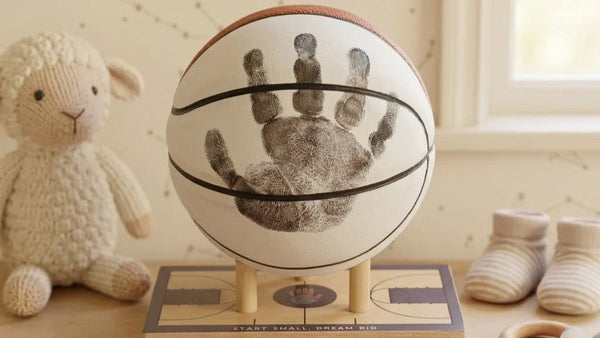
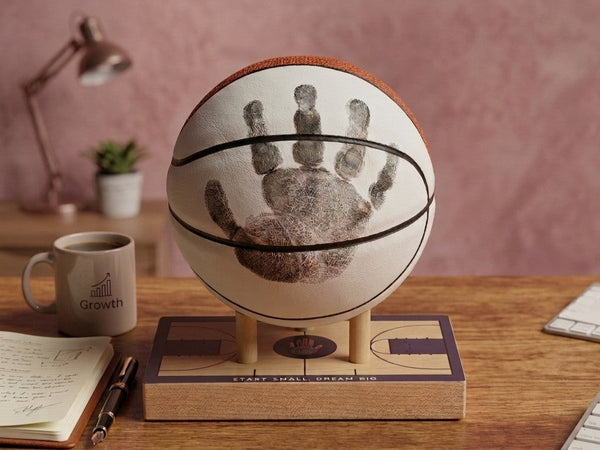
Paper works. A card in a memory book works. But if the sports-family version of this appeals to you, a three-inch newborn handprint on a basketball or football, sealed to last, sitting on a display base where everyone can see it, we wrote the full step-by-step for putting a handprint on a basketball. Same technique as above for the hand. Different canvas entirely.
Their hand won't stay this small. The print will.