Touchprints
How to get a toddler's handprint (when they won't hold still)
A newborn makes a fist because of a reflex. A toddler makes a fist because they've decided to.
Nobody warns you about that part. By one or two, the hand opens fine. It's everything attached to the hand that won't cooperate: the arm that wants the ink pad, the legs that want down, and the opinion about the whole idea.
Quentin and I put every kit together by hand in Austin, Texas, and we're both dads. So here's the toddler version of the handprint, start to finish, with the one step worth slowing down for.
How do you get a toddler's handprint?
Pick a calm moment, wipe the hand clean and dry, press the palm flat on the ink pad, then set the hand down in one motion and lift it straight up. That's the whole method. With our kit, the ink part takes about ninety seconds.
The ninety seconds go better with a little setup. Do it after a nap or a snack, not right before one. If you have two adults, one holds the toddler on a lap and the other handles the ink and the ball.
Let them press the ink pad themselves first. It turns the part they'd fight into the part they get to do. (They will also try to press it on you. Plan for that.)
The hand goes down once and comes up once. Everything else is setup.
Is a toddler's hand easier to print than a newborn's?
Yes, the hand itself is easier, because the palmar grasp reflex that keeps a newborn's fingers curled fades around 4 to 6 months (NCBI StatPearls). The toddler is the harder part.
A newborn's fist is involuntary, and you can coax it open. A toddler's fist is a decision. If you're working with a younger baby, our newborn handprint how-to covers getting those fingers open.
Our kits are made for little hands, from about two months to about six years. There's no age limit, though. Grandparents make great prints too.

How do you keep a toddler's handprint from smudging?
Hold the surface still yourself and lift the hand straight up, with no slide on the way out. This is the step to slow down on.
Here's how I'd do it. Put your hand over the back of theirs, palm against knuckles. Lower the inked hand onto the ball. Press the palm, then press each finger once, thumb last. Then lift both hands together, straight up, like you're picking a sticker off the ball.
Before any ink comes out, line the hand up. Hover the clean hand over the white panel and find the middle. Here's my admission: Hadley's first ball has her handprint on it, and the print wasn't centered. That's why I'd hover first.
Hover first, then ink, then press.
The alcohol prep wipe does two jobs here. It gives the ball a clean surface before you print, and afterward it takes the ink off little hands, ideally before they reach the couch.
Why put a toddler's handprint on a ball instead of paper?
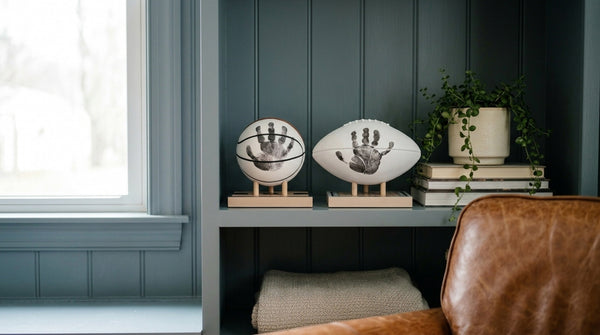
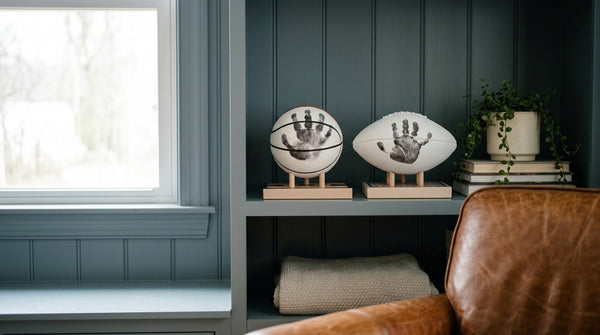
Because a ball on a display base stays out on a shelf, and paper usually ends up in a drawer. A keepsake that lives in a bin isn't doing its job. That's an opinion, and I'll defend it.
Quentin's son Parker has his handprint on a basketball in Quentin's living room. It's out where people see it, which is the point of making one.
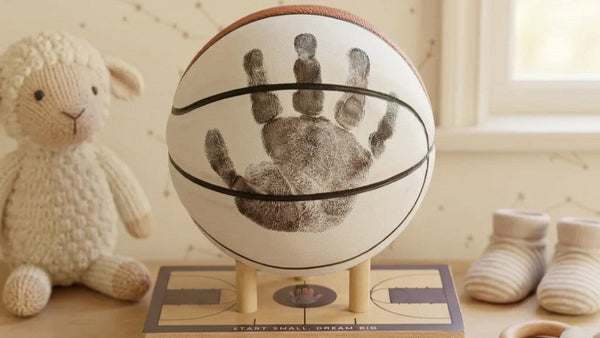
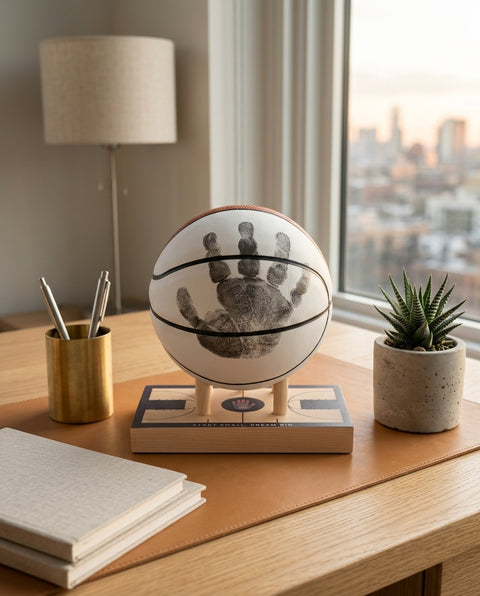
If the sports version of this appeals to you, start with the Basketball Handprint Kit in maple: a 5-inch display-quality sports ball on a solid maple display base, $44.99 USD with flat rate shipping within the US. Maple suits a kid's room shelf. Football family? The kit also comes with a 5x8 inch display-quality football.
Basketball Handprint Kit Maple
The Little Touchprints Basketball Kit preserves your child’s handprint on a 5-inch display-quality basketball. It’s mounted on a...
See the kitEverything's in the box: the ball with a white panel for the print, a child-safe ink pad, an alcohol prep wipe, brush-on sealant, and the display base. The bases are solid walnut or solid maple, not a stain or finish over another wood.

How long does a toddler handprint take?
About 15 minutes start to finish, not counting dry time. The ink part is about ninety seconds of that.
Then the ink needs at least 2 hours to dry before the sealant goes on. The sealant brushes on like nail polish, and that part is for an adult, not the toddler. Ink before a nap, seal after it, and the timing mostly takes care of itself. If you want the full walkthrough, read the how-to first.
What else do parents ask about toddler handprints?
Is the ink safe on a toddler's skin?
The kit uses a child-safe ink pad, and the prep wipe cleans little hands when you're done. For more on keeping it tidy, see how to get a baby's handprint without the mess.
What if my toddler won't open their hand?
Stop and try again after the next nap. A toddler who has decided against it won't be talked out of it in the moment. The hand will still be there tomorrow.
Is clay or ink better for a toddler handprint?
Ink asks less of a toddler, because the hand only has to stay down for a moment. We compared clay, ink, framed prints, and sealed balls honestly in how to preserve a baby's handprint, every method compared.
Basketball or football for a toddler's handprint?
Go with the sport your family already follows. The basketball is 5 inches, and the football is 5x8 inches. Both come on a solid walnut or solid maple display base.
Where should a toddler's handprint end up?
Somewhere low enough for them to point at it.
Toddlers love finding themselves in things. Put the ball on a shelf they can see from the floor, and let them show you whose hand that is.
Little Touchprints makes handprint keepsake kits for sports balls, basketballs and footballs, with everything included: child-safe ink pad, prep wipe, brush-on sealant, and a walnut or maple display base. Built to be displayed, not stored. Questions about the process? Our FAQ has you covered.

Preserve this season before the next one starts.
Shop the kits