Touchprints
How to get a baby's handprint without the mess (from someone who ruined a few)
The first time I tried to take my daughter's handprint, I got ink on the ball, ink on the table, ink on her wrist, and no print worth keeping. Quentin and I ruined dozens of basketballs figuring this out before we sold a single kit. So when a parent asks how to do this without turning the kitchen into a crime scene, I have opinions, and most of them were paid for in ruined basketballs.
Here is the thing nobody tells you. The mess is not really about the ink. It is about the setup. Get the setup right and the print is the easy part.
How do you get a baby's handprint without making a mess?
You get a clean handprint by controlling three things before any ink touches skin: a contained work surface, a child-safe ink pad instead of loose paint, and one adult whose only job is to hold the hand. Do those three and the mess stays where it belongs.
I know that sounds obvious. It was not obvious to me at 11pm with a squirming six-week-old and a paper towel supply I was burning through fast. Paint gets everywhere because it goes on wet and stays wet. A child-safe ink pad transfers a thin, even layer and leaves a cleaner edge, which is why our kit uses one instead of a jar of paint.

What is the cleanest method for a newborn?
For a newborn, the cleanest method is to print while they sleep, using a child-safe ink pad and a prep wipe, with one person supporting the wrist and one guiding the ball. Two hands beat one, every time.
Newborns keep their hands balled up. That is not stubbornness. It is the palmar grasp reflex, and it usually fades between 4 and 6 months (Cleveland Clinic has the plain-English version). So you are not prying a tiny fist open by force. You wait for the drowsy stretch right after a feed, then stroke the back of the hand until the fingers loosen on their own.
The script in our house went like this.
Me: Is she asleep?
My Wife: She's asleep.
Me: Fully asleep?
My Wife: Go for it
Ink pad or inkless, which one makes less mess?
Both can be clean, but a child-safe ink pad gives you more control on a curved surface like a ball, while inkless paper is tidiest on a flat card. For a print you are putting on a display-quality basketball, the ink pad wins.
Inkless kits are good, and if you only want a print on a flat card, they are hard to beat. But we are not making cards. We are preserving a handprint on a 5-inch display-quality ball that sits on a shelf, and a curved surface needs an even, controllable transfer. That is the ink pad. One wipe with the included prep wipe and the hand is clean again.
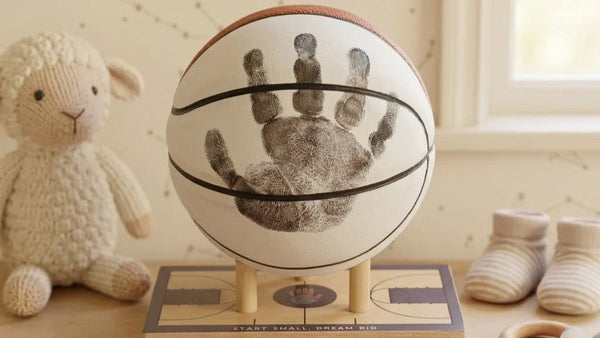
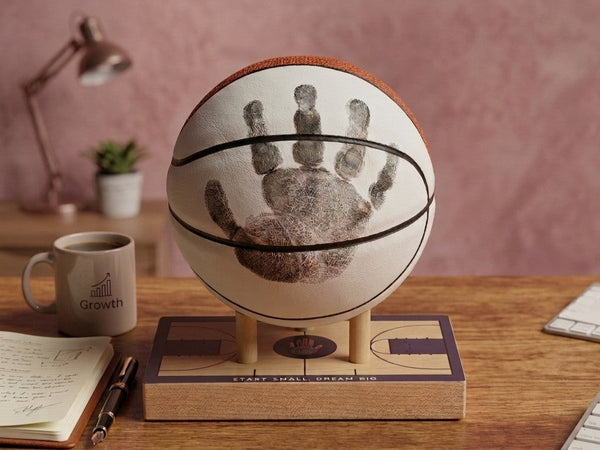
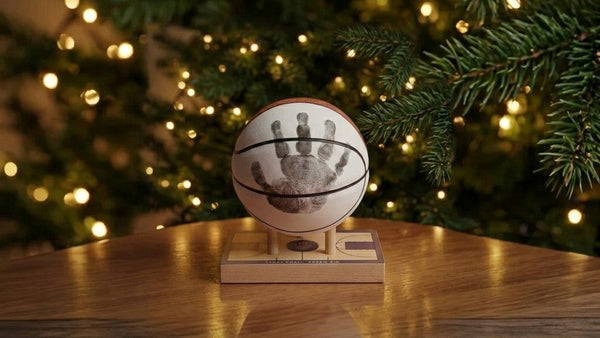
If the sports version of this appeals to you, that is the whole idea behind what we make. The handprint goes straight onto the ball, not onto a card that ends up in a drawer. You can see the basketball kits here, and the maple basketball kit is the one most people pick for a nursery shelf.

Football Handprint Kit Maple
Before they’re big enough to throw a spiral, there’s this. The Little Touchprints Football Kit captures your baby’s...
See the kitHow do you clean up if it does get messy?
Wipe the skin first with the child-safe prep wipe while the ink is still fresh, then the surface, then yourself. Fresh ink lifts in one pass. Dried ink takes three.
Speed matters more than scrubbing here. The prep wipe in the kit is there for exactly this moment. And if the first print smudges, that is fine. That is why you set up a practice ball or a scrap first. Do one to learn on, keep the one that counts.

Quick answers
Can I take a newborn handprint at home without a professional?
Yes. With a child-safe ink pad, a prep wipe, and a second set of hands, home prints come out as clean as studio ones. Our step-by-step for newborns walks through it.
What if my baby will not open their hand?
Wait for sleep and stroke the back of the hand until it relaxes. The grasp reflex fades by about 6 months, so timing gets easier, not harder.
Will the print smear after it dries?
Not once it is sealed. We finish every ball with a brush-on, water-based sealant applied like nail polish, so the print stays put. Here is how we preserve it on a basketball.
How long does the whole thing take?
About twenty minutes, and most of that is setup. The print itself takes seconds.
We still have the second ruined basketball in the garage. Faint half-print, ink dried in the seams, the one we did not keep. The one we did keep is on a shelf in her room, walnut base, a hand smaller than a plum. She is four now, and she puts her whole palm flat against it to see how much bigger she has gotten.
Little Touchprints makes handprint keepsake kits for sports balls, basketballs and footballs, with everything included: child-safe ink pad, prep wipe, brush-on sealant, and a walnut or maple display base. Built to be displayed, not stored.
Questions about the process? Our FAQ has you covered.

Preserve this season before the next one starts.
Shop the kits