Touchprints
The Handprint in the Shoebox Was Barely There Anymore
My mom has kept a shoebox on the top shelf of the shelving in the garage, behind a stack of boxes that nobody has looked at since the first Bush administration. Last spring she got it down for us. Inside: a hospital bracelet, three photos with the date printed in orange in the corner, and a folded piece of cardstock with my handprint on it from 1994.
Except it wasn't really a handprint anymore. It was a suggestion of one. A gray-brown smudge with a thumb you could sort of find if you already knew where the thumb was supposed to be.
She held it up. "You can see it, right?"
We both said yes. Neither of us could see it.
That's the reason I get a little tense when someone tells me they already took their baby's prints and they're "somewhere safe." Somewhere safe is usually a drawer. And a drawer, it turns out, is not safe at all.
Do handprint keepsakes actually fade over time?
Yes. Most paper-based handprint keepsakes fade noticeably within ten to twenty years, and the ones stored in drawers and photo boxes often fade faster than the ones hanging on a wall.
That last part surprises people, so let me say it again: the drawer is not protecting it.
Light gets blamed for everything, and light is genuinely a factor. But a folded card in a shoebox is also absorbing whatever the humidity is doing in that closet, every summer, for two decades. Paper swells. Paper releases. Ink migrates into the fibers until the crisp edge of a pinky becomes a soft gray cloud.
Twenty years of that is a long time.
Why do baby prints fade in the first place?
Three things do the damage, roughly in this order: the ink, the surface underneath it, and the environment around both.
The ink. A lot of standard stamp pad ink is dye-based, meaning the color is dissolved rather than suspended. It's bright on day one and unstable over decades. Pigment-based ink holds up far better, because the color sits as actual particles rather than a solution waiting to break down.
The surface. This is the one nobody talks about, and it matters most. Untreated paper is acidic. It yellows on its own, with no help from anybody, and as it yellows the contrast between print and background collapses. You don't need the ink to disappear for the print to become unreadable. You just need the background to catch up to it.
The environment. UV light, temperature swings, humidity swings, handling. Every time somebody pulls the card out to show a cousin, a little oil goes onto it.

How do you store baby prints so they don't fade?
Keep the print out of sunlight, flat rather than folded, in an acid-free sleeve or behind UV-filtering glass, in a room with stable temperature and humidity, and handle it as little as possible.
Practically: interior walls over sunny ones. Not the bathroom, not the attic, not the garage. A normal living room, not a bin above the water heater. Acid-free everything, because the paper touching your print matters almost as much as the print itself.
That's the real answer, and it's the same one any archivist would give you.
It's also, if you read it again, a set of instructions for hiding something.
Is that actually what you want?
Here's where I'll admit my bias, because I own a keepsake company and you should weigh what I say accordingly.
Every piece of advice up there is about protecting a fragile object from the world. Keep it dark. Keep it flat. Keep it untouched. It's museum protocol, and museums are wonderful, and I have never once heard anybody describe their favorite childhood memory as "the thing my mother kept in an archival sleeve."
So there's a level system here, and I'd rank it about like this.
Level 1: Paper, folded in a drawer. Fades fast, gets found once a decade, generates one sad conversation in a kitchen.
Level 2: Acid-free paper, framed under UV glass, hung on an interior wall. Genuinely good. Requires you to have done four things correctly during a week when you were sleeping in ninety-minute increments.
Level 3: A surface that isn't paper at all, sealed, put somewhere you look at it on purpose.
Level 3 is not a clever trick. It's just changing the variable everyone else optimizes around. If the fragile thing is the paper, stop using paper.
What makes a sealed print last longer?
A sealed print lasts longer because the sealant puts a physical barrier between the ink and everything that degrades it: air, moisture, oils from hands, and abrasion.
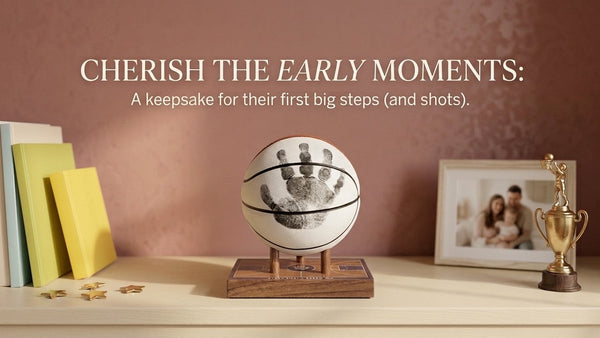
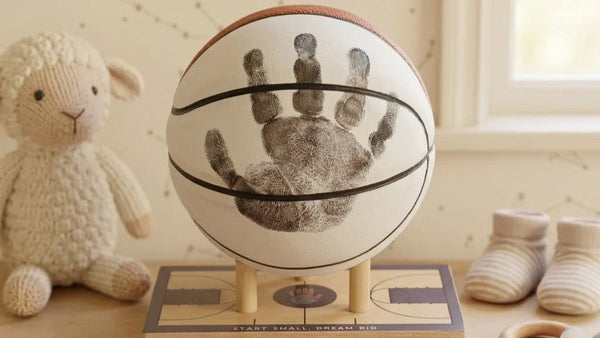
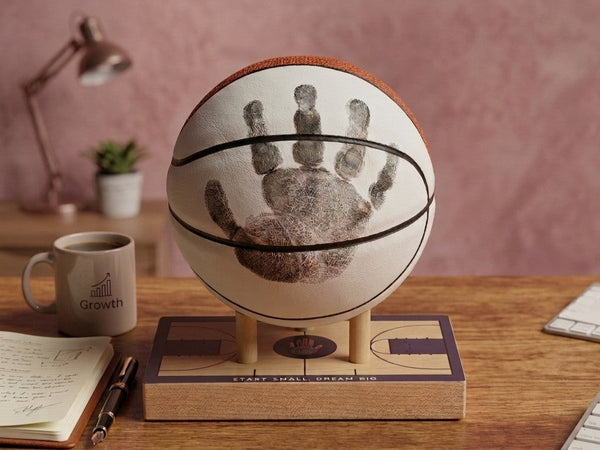
Our kits use a brush-on water-based sealant, applied like nail polish, over a print made with a child-safe ink pad on a display-quality sports ball. The ball isn't paper, so it isn't acidic and it isn't going to yellow underneath the print. The sealant goes on thin, dries clear, and locks the print where it is. Then the ball sits on a walnut or maple display base, where somebody can pick it up without a conversation about oils and archival sleeves.

Football Handprint Kit Maple
Before they’re big enough to throw a spiral, there’s this. The Little Touchprints Football Kit captures your baby’s...
See the kitThe step-by-step version of getting a clean print onto a curved surface is in our full basketball handprint walkthrough. If you're still deciding between methods altogether, we compared every common approach side by side without pretending ours is the only reasonable one. To see a finished one, the basketball kits are here.
Quick answers
Do inkless print kits fade?
Inkless kits can fade, sometimes faster than standard ink, because the reaction depends on a coated paper that is chemically active by design. That coating keeps reacting over time. Inkless is excellent for keeping mess off a newborn's skin. It is not automatically more permanent.
Can you fix a handprint that's already faded?
Not really. You can scan or photograph it at high resolution and preserve the image, which is worth doing today rather than next year. The original can't be restored to its original contrast.
How long does a sealed handprint on a ball last?
Indefinitely under normal indoor display conditions. The failure mode for a sealed print isn't fading, it's physical damage, so keep it on a shelf and out of the rotation for driveway games.
Should I make more than one print?
Yes. Make two or three while you have the hand in front of you. Newborn hands stay cooperative for about four minutes total, and you don't get that window back.
Back to the shoebox
We took a photo of my handprint before my mom put the box back on the shelf. It's on my phone now, which means we saved it thirty-two years late, at about ten percent of the original quality.
My daughter's handprint is on a basketball sitting on my desk. No stepladder. Nobody has to say "you can see it, right."
I get to see it everyday.
Little Touchprints makes handprint keepsake kits for sports balls, basketballs and footballs, with everything included: child-safe ink pad, prep wipe, brush-on sealant, and a walnut or maple display base. Built to be displayed, not stored.
Questions about the process? Our FAQ has you covered.

Preserve this season before the next one starts.
Shop the kits