Touchprints
Comparing 5 Methods to Preserve a Baby's Handprint
Updated October 2026
You have a tiny hand you want to keep, and about a dozen ways to do it. This is a plain comparison of the real options to preserve a baby's handprint, ink, inkless, clay, plaster, and a sealed keepsake you can actually display, so you can pick the one that fits your baby, your patience, and the shelf you want to fill. No single method wins for everyone.
Quentin and I learned that the slow way. We tried paper and ink first. Then we ruined more than a dozen balls getting the version we sell right: the wrong leather, the wrong ink, and more smears than we'd like to admit. And I grew up on the classic options. As a kid I made all of them. My parents kept exactly one, in a baby book that never gets pulled out.
What to Consider Before You Pick a Method
A few things decide which method is right for you, so it helps to weigh them before you buy anything.
Mess and safety. Newborn skin is sensitive, and most parents want a method with a child-safe ink pad or no ink at all. Anything that heats as it cures belongs in a different column entirely (more on plaster below).
Your baby's age and mood. A two-week-old keeps a curled fist most of the day. A six-month-old grabs everything. The method that works at one age can be a wrestling match at another.
Whether it lasts. Paper fades. Clay chips. Some keepsakes are built to sit in a drawer, and some are built to sit on a shelf for twenty years. Decide up front which one you are making.
Where it ends up. A print you have to store flat in a box is a print you will forget. A keepsake that stands up on its own, on a desk or a nursery shelf, is the one you will actually see.

What Are the Main Ways to Preserve a Baby's Handprint?
There are five methods most parents actually use: ink prints, inkless prints, clay or dough impressions, plaster casts, and sealed display keepsakes. Each trades off mess, permanence, and how good it looks a year later.
Ink prints on paper or canvas
Best for: the classic framed print, cheap and fast, if you do not mind a little cleanup.
Ink prints are the method most of us picture first. You press your baby's hand onto a child-safe ink pad, then onto paper or canvas, and you have a keepsake in under a minute. It is the most affordable route and the easiest to frame. The catch is fade. Ink on uncoated paper loses contrast over years unless you seal it and keep it out of sunlight, and a print left loose in a baby book tends to smudge before it ages.
Inkless prints
Best for: newborns from day one, and parents who want zero mess on the skin.
Inkless kits use a wipe and specially coated paper, so nothing pigmented ever touches your baby. The hand looks clean the whole time, the print develops on the paper, and it is genuinely the neatest option for a squirming newborn. The tradeoff is that inkless prints live on small proprietary cards, so your display options are narrower, and the detail can be fainter than a good ink print.
Clay or salt-dough impressions
Best for: a three-dimensional keepsake with real depth, if you have an afternoon.
A clay impression captures every crease of the hand in relief, which is why so many parents love it. You press the hand into rolled air-dry clay, then let it cure, often 48 hours a side. It photographs beautifully. It is also the most fragile of the group: clay chips at the edges, cracks if it dries unevenly, and does not survive a move without careful packing. We do a deeper comparison between the two here.
Plaster casts
Best for: a museum-style 3D replica, for parents who want the most detailed keepsake and will handle the process carefully.
A plaster cast makes a solid, three-dimensional copy of the hand, fine lines and all. It is the most lifelike option. It is also the most involved, and it comes with a real safety note: never pour plaster directly around a baby's hand or foot, because plaster heats as it sets and can cause burns. Safe kits take a soft-compound impression first, then pour plaster into that mold, away from the baby.

Sealed display keepsakes
Best for: the one you will still have, and still see, in twenty years.
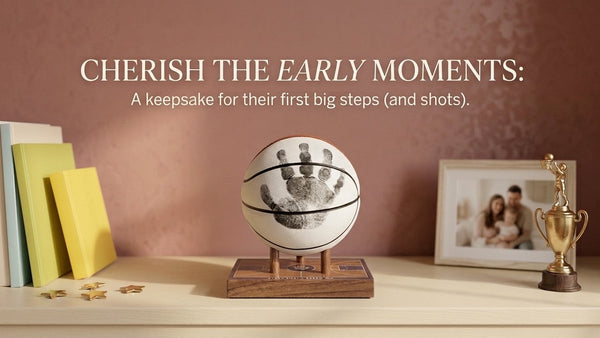
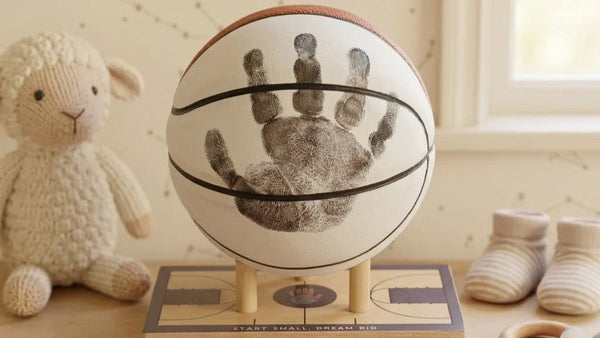
This is the method we build, so read it with that in mind. The ink part takes about ninety seconds, and the whole thing runs about 15 minutes, not counting dry time. The ink needs at least two hours before the brush-on sealant goes on. The alcohol prep wipe cleans the ball first, and it takes the ink off little hands afterward. Quentin and I assemble every kit by hand in Austin, Texas. The base is solid walnut or solid maple, because we wanted something that looked like it belonged in an office.
Which Method Lasts the Longest?
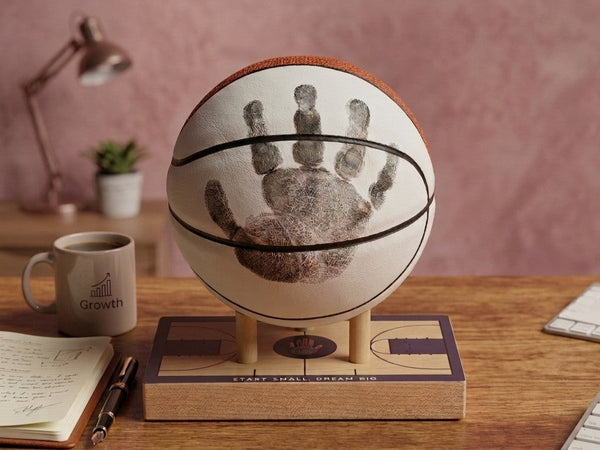
The longest-lasting handprint is a sealed one, whether that is a sealed print or a solid cast, kept out of direct sun. Our own proof is young, but it's real. The oldest ball we've sealed is Hadley's, my daughter's handprint on a basketball. It has sat on my desk for almost two years, and it still looks the way it did the day we sealed it. Our early test prints didn't fare as well. The wrong leather and the wrong ink smeared before we ever got to the sealant.
Permanence comes down to two things: sealing the print so the pigment cannot lift or fade, and giving it a form that does not chip or curl. An unsealed ink print on paper is the most fade-prone, a plaster cast is durable but heavy and easy to drop, and a sealed print on a hard, displayed surface splits the difference. If you want to go deeper on the sealing step itself, our how-to guide on preserving a handprint on a basketball walks through the brush-on sealant process start to finish.

The Sports-Family Version
If the person you are making this for is a sports family, the method choice gets easier. The keepsake that fits a nursery full of little jerseys and a dad who still checks the box score is the one that leans into that, a handprint preserved on a basketball or football instead of a plain card. It's also why we started. I wanted Hadley's handprint on something I love, and I wanted to be proud to display it at the office. Quentin's version is Parker's handprint on a basketball in his living room. It works as a first birthday keepsake, a new-parent gift, a grandparent gift, or the baby-shower present that does not get returned. Everything-included matters here: a child-safe ink pad, a prep wipe, the brush-on sealant, and a real wood base, so the person opening it is not sourcing craft supplies at 9pm. You can see the full lineup on our basketball keepsake collection.

Basketball Handprint Kit Walnut
Some keepsakes go in a box. This one goes on a desk. The Little Touchprints Basketball Kit preserves...
See the kit
Basketball Handprint Kit Maple
A baby’s hand is impossibly small. And then it isn’t. The Little Touchprints Basketball Kit captures that moment...
See the kitQuick Answers
What is the safest way to preserve a newborn's handprint?
The safest methods are a child-safe ink pad or an inkless kit, both designed for newborn skin. Avoid pouring plaster directly on a baby's hand, since plaster heats as it cures and can burn.
When can you take a newborn's handprint?
You can take a print in the first days, though a newborn's fist stays curled, so many parents find it easier around the time the hand opens more naturally. Our companion post on handprint versus footprint for a newborn covers the timing and the grasp reflex in detail.
How do you keep a handprint from fading?
Seal it and keep it out of direct sunlight. A water-based brush-on sealant protects the pigment, and a hard displayed surface holds up far better than loose paper in a book.
Ink or inkless, which is better?
Inkless is neater and touches nothing but a wipe, which parents of newborns love. A child-safe ink pad gives crisper detail and more display flexibility. Both are safe, so it comes down to mess tolerance versus print sharpness.
Do I have to frame it?
No. Framing is one path, but a keepsake that stands on its own, like a sealed print on a display base, skips the frame and is more likely to stay out where you see it.

Picking Yours
There is no wrong method here, only the one that matches how you want to remember this. Ink on canvas is cheap and fast. Inkless is mess-free from day one. Clay or a safe plaster kit gives you depth. And a sealed keepsake on a display base is the one you will still have, and still see, in twenty years. Whatever you choose, the goal is the same: freeze this moment on something you will actually keep looking at.
If you have read this far, you already know where we landed. Every method here does something, but most of them end up in a drawer, and a drawer is where keepsakes go to be forgotten. That is the whole reason we built what we build: a handprint preserved on a display-quality basketball, sealed with a brush-on coat so it actually lasts, mounted on a maple base that suits a nursery shelf instead of a memory box. The one from my childhood is in a baby book nobody opens. Hadley's is on my desk.
Little Touchprints makes handprint keepsake kits for sports balls, basketballs and footballs, with everything included: child-safe ink pad, prep wipe, brush-on sealant, and a walnut or maple display base. Built to be displayed, not stored.
Questions about the process? Our FAQ has you covered.

Preserve this season before the next one starts.
Shop the kits