Touchprints
Ink pad or clay for a newborn handprint: which one actually works?
Our first clay disc is still in a kitchen drawer, cracked clean across the middle. My wife pressed our daughter's hand into it when she was nine days old. We followed the instructions. It dried two days on the counter, and on the third morning there was a crack running right through his palm line. So when a parent asks whether to use an ink pad or clay for a newborn handprint, I have a real answer. It cost us that disc to learn it.
Here is the honest head-to-head, including the safety question everyone asks and the part nobody mentions until their keepsake is already cracking.

Which is easier for a newborn, ink pad or clay?
An ink pad is easier for a newborn, because it needs about one second of contact instead of a firm, sustained press into clay.
Here is the thing nobody tells you. Newborns keep their hands balled up. That is the palmar grasp reflex, and most babies hold onto it until somewhere around 4 to 6 months (Cleveland Clinic). Clay wants a wide, flat, open hand pressed deep enough to leave every line. Try that with a nine-day-old and you get a smear, or a fist-shaped dent, or a crack later when the thin spots dry.
An ink pad works with a fisted baby. You roll one finger at a time if you need to, catch the hand in the half-second it opens, and you are done. If it smears, you wipe and try again. You cannot un-press clay.
Is inkless ink safe for a newborn's skin?
Yes. Inkless wipe kits use the same print method hospitals use to record a newborn's footprint at birth, and they leave nothing visible on the skin (BabyRice, one common inkless kit).
We use a child-safe ink pad instead of an inkless wipe, and I will tell you why. Inkless is genuinely clever, but it prints onto special coated paper, not onto a curved ball. A child-safe ink pad gives a crisp, dark print you can preserve on a display-quality sports ball and seal in place. Every kit also includes an alcohol prep wipe, so the ball takes the ink cleanly and the print holds its edges.
Which one actually lasts on a shelf?
A sealed print lasts longer than raw clay, because clay keeps shrinking and cracking for weeks after you think it is done.
That is the lesson our drawer taught us. Air-dry clay loses moisture unevenly, so the thin spots pull against the thick ones and split. Ink on paper has the opposite problem: it does not crack, it just fades in a drawer where you stashed it "somewhere safe." Both methods quietly lose the print you were trying to keep.
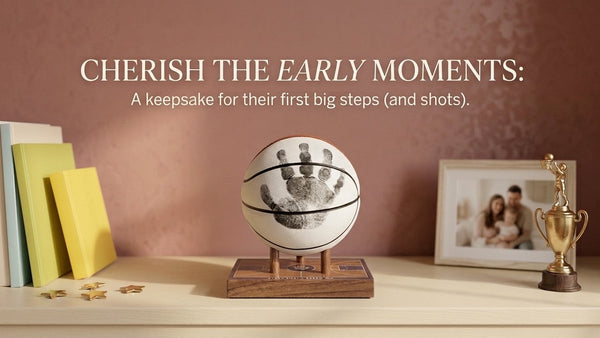
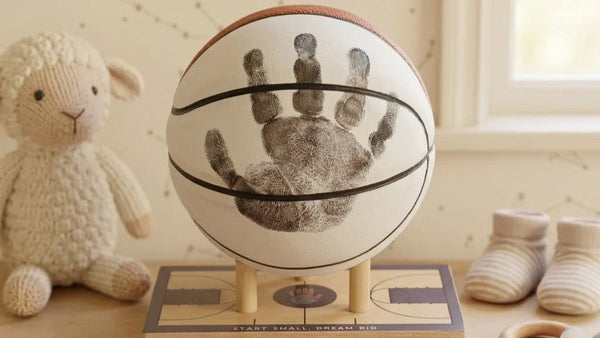
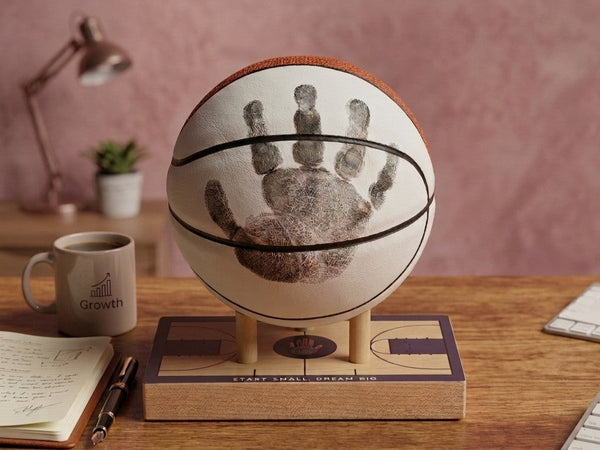
Our fix was to stop hiding the print and start displaying it. You preserve the handprint on a display-quality basketball, brush on a water-based sealant like nail polish, and it is dry to the touch in about twenty minutes. Then it sits on a maple base on the nursery shelf where you see it every day. That is the whole idea behind how we preserve a handprint on a basketball, and it is why a sealed ball outlasts a clay disc. If you want the deeper version, here is how to keep baby prints from fading.

If the sports version of this appeals to you, that is our whole line. It is a handprint keepsake for a newborn, printed on a display-quality basketball, mounted on a maple base, built for the nursery shelf and given at showers and first birthdays. You can see the basketball kits here, and the maple finish is the one most parents pick for a nursery: Basketball Kit in maple.

Basketball Handprint Kit Maple
A baby’s hand is impossibly small. And then it isn’t. The Little Touchprints Basketball Kit captures that moment...
See the kitSo which should you pick?
If you want the easiest print and the one most likely to still look right in twenty years, use a child-safe ink pad and seal it onto something you will actually display.
Clay is not wrong. It makes a lovely 3D impression, and if you want the tactile version, go for it and dry it slowly out of direct sun. But for a fisted newborn, on a real deadline, with a keepsake you want on a shelf and not in a drawer, an ink pad is the easier and steadier choice. Ours is on the shelf above the crib. The clay one is still in the drawer, still cracked, and I keep it there on purpose so I remember which one we got right.
What else do parents ask?
Can you use a regular office ink pad on a baby?
No. Use a child-safe ink pad made for skin. Office stamp ink is not formulated for a baby's hands, and it is harder to clean off.
What if the print smears the first time?
Wipe it off and try again. With an ink pad you get as many attempts as you need, which is the main reason it beats clay for a wiggly newborn.
When is the best time to take the print?
Earlier is easier while the hand is still tiny, but any time works. Here is the best time to take a baby's handprint if you want the full timing answer.
Little Touchprints makes handprint keepsake kits for sports balls, basketballs and footballs, with everything included: child-safe ink pad, prep wipe, brush-on sealant, and a walnut or maple display base. Built to be displayed, not stored.
Questions about the process? Our FAQ has you covered.

Preserve this season before the next one starts.
Shop the kits